
Before 1875, hockey — or something close to it — was played the way informal sports usually are: outdoors, on frozen ponds and rivers, with rules that shifted depending on who showed up and how many players were on each side. It was recognizably hockey-ish, but it wasn't yet a sport with a fixed structure.
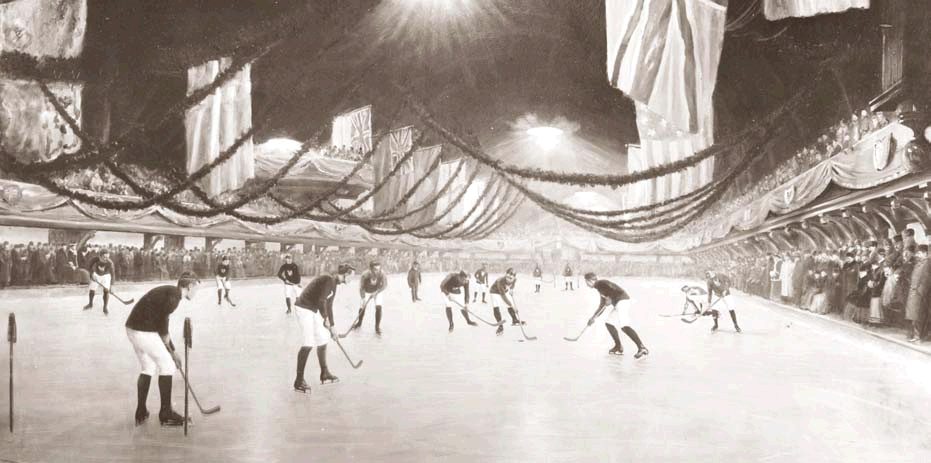
That started to change on March 3, 1875, at the Victoria Skating Rink in Montreal. A game organized by James Creighton, a Nova Scotia-born engineer and athlete, is widely credited as the first organized indoor hockey game played under a set of written rules. Creighton adapted concepts from field hockey and rugby, drew up nine players per side, and got two teams of Montreal's athletic elite onto the ice for what was, at the time, simply a novelty exhibition.
One detail from that night matters more than it might seem: the game reportedly used a flat wooden disc instead of a ball. Outdoor stick-and-ball games had used actual balls, which bounced unpredictably and were prone to flying into the crowd. A flat puck stayed on the ice and moved more predictably — a small equipment change that shaped how the sport would be played from that point forward.
The game itself wasn't exactly a clean debut. Newspaper accounts from the time describe a rough, physical contest that spilled into the crowd, damaged some of the rink's furniture, and left at least one spectator unhappy enough to write about it. Hockey's reputation for physicality, it turns out, goes back to its very first organized game.
What made the Victoria Skating Rink game matter wasn't that it was polished — it wasn't. It mattered because it was repeatable. Two years later, students at McGill University codified a more formal set of rules based on that same template, and organized hockey began spreading through Montreal's athletic clubs. Within a couple of decades, it had spread across Canada, then into the northern United States, eventually leading to leagues, trophies, and everything that followed.
Every rulebook, every league, every version of the sport played today traces back to that decision to move the game indoors, onto a defined sheet of ice, with a flat puck and a set of rules two people could actually agree on.